

Perhaps You’ve Heard This Before.
Here’s a story I see play out all too often.
Two business partners (sometimes family members, sometimes longtime “friends”) form an LLC to operate a business or investment.
Things go well for a time, but then the members have differing viewpoints. Perhaps one member wants all of the profits to be distributed out of the business for personal reasons (as had been the case for many years of the LLC’s operations), while the other member now wants to hold the profits in the LLC to invest in an opportunity to grow the LLC’s holdings. Or perhaps the members just aren’t getting along and otherwise start to disagree about how the business should operate.
So, one member decides to assert more control over the business. He or she removes the other member from the LLC’s bank accounts and credit cards, stops providing that member with financial information about the LLC’s operations and performance, makes a large “loan” to himself or herself from the LLC’s assets, or otherwise takes unilateral action to “freeze out” the other member to gain control over the LLC. Maybe he or she even takes it a step further and decides, because distributions have now stopped being made to the members and one member is short on cash, to make a low-ball offer to buy out the other member’s interest.
What Can an Operating Agreement Do to Protect Me?
An LLC operating agreement can (and should) address many scenarios to provide clear “do’s” and “don’ts” for what LLC members can do in times of conflict.
Most jurisdictions provide significant flexibility for the members to allocate rights and responsibilities as they see fit, so long as they clearly agree.
Because an operating agreement is a contract among the members (and often the company itself), if a manager or member violates the provisions of an operating agreement, other members and the company itself can generally pursue breach of contract claims to enforce the specific terms of the operating agreement or pursue specific remedies set forth in the operating agreement such as a buyout of the membership interest and/or expulsion of a member.
However, where an operating agreement is either silent on the oppressive member’s actions or on the remedies available for a member’s wrongful conduct, what options does the “frozen out” shareholder have?
If the Operating Agreement is Silent – Or If I Don’t Have an Operating Agreement, What Are My Remedies?
The answer depends on what law governs the LLC.
The most drastic remedy – available in each of the District of Columbia, Maryland, and Virginia – is judicial dissolution. A court will order the dissolution of the LLC, a winding up of its affairs and payment of creditors, and a liquidation of the remaining assets. The court may appoint a receiver for this purpose to oversee the liquidation process, taking it out of the hands of the individual members.
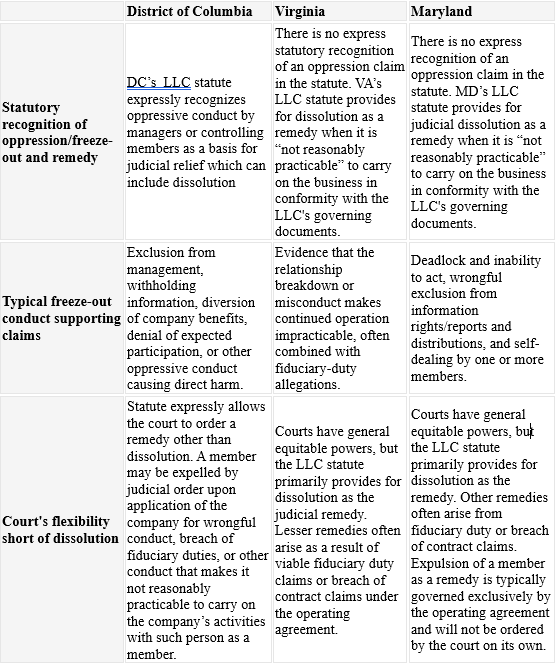
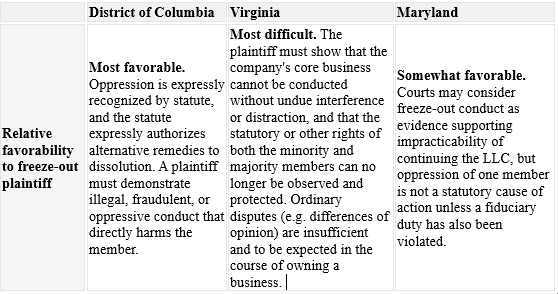
Of these three jurisdictions, DC provides the strongest statutory framework for what is commonly known as an LLC member oppression claim. Member oppression is expressly recognized in the statutes, and the statute provides courts with significant flexibility to fashion remedies short of a dissolution of the entire LLC.
Virginia and Maryland courts, on the other hand, tend to focus on whether a member has violated his or her fiduciary duties as part of the allegedly oppressive conduct. If so, those claims may be pursued without resorting to judicial dissolution. On the other hand, and in the absence of a clear breach of fiduciary duty claim (which is beyond the scope of this article), a Maryland or Virginia LLC member’s recourse may be limited to seeking judicial dissolution of the LLC itself.
Below is a table summarizing some of the similarities and differences in member oppression rights and remedies in DC, Maryland, and Virginia. While not exhaustive and for illustration purposes only, one can see from the table that the jurisdiction where the LLC is formed can have drastic differences in the remedies an LLC member may pursue for oppression claims.
Concluding Thoughts
When a business is formed, a carefully crafted and conscientiously drafted operating agreement (not the result of AI or Legal Zoom) can plan ahead for conflict and offer business owners reassurance of how conflict would be resolved short of an owner going to court and seeking the dissolution of the business.
In the absence of an operating agreement, aggrieved business partners should promptly seek the advice of legal counsel to understand what their rights and obligations might be.
Are you a business owner who wants help with an operating agreement or with a difficult partner? Please contact Tim Canney, chair of the business and tax practice at Bulman Dunie, for assistance. Tim can be reached at (301) 656-1177 x331 or tcanney@bulmandunie.com.


